Where did it fall?
A young man drops a borrowed axe head into the Jordan, and the prophet asks one question: where did it fall? God does not restore what we refuse to locate.
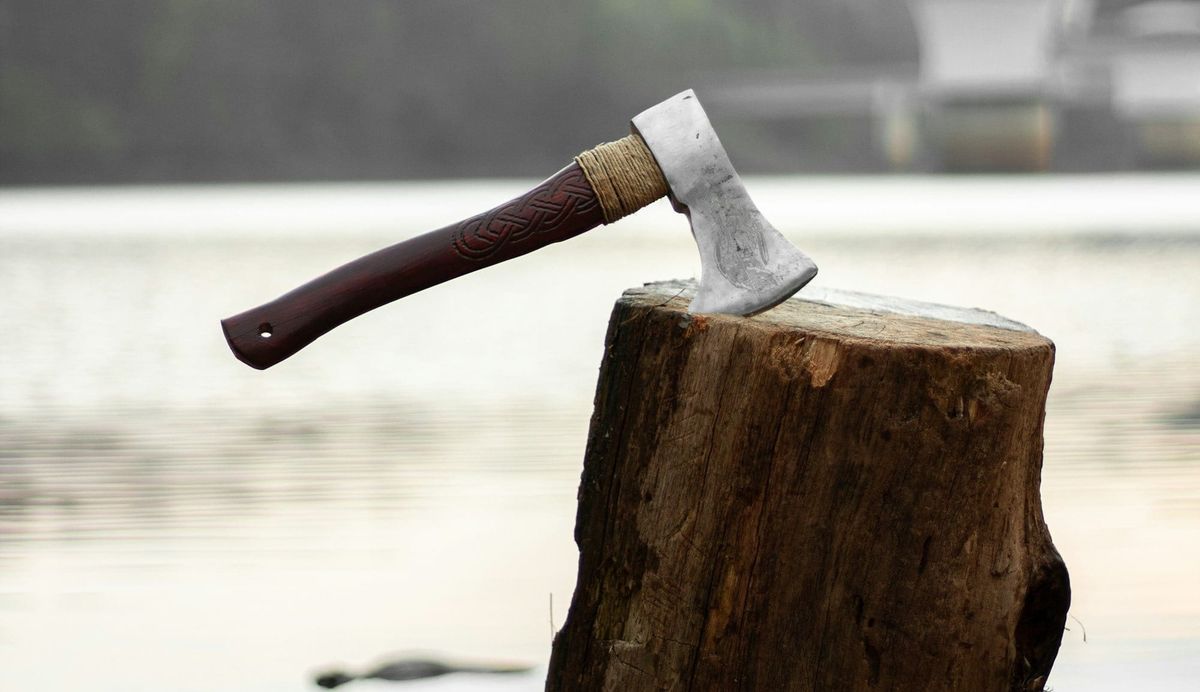
I have been sitting with 2 Kings 6 for a few weeks now, and the line that keeps stopping me is not the miracle. It is the question.
A young man is cutting timber by the Jordan. The axe head comes off the handle, goes into the water, and sinks, because that is what iron does. He cries out, "Alas, my master! It was borrowed." And the prophet standing on the bank does not say a word about carelessness. He asks one thing.
"Where did it fall?"
Seven verses. No kings, no armies, no fire from heaven. One poor man, one sunken tool, one river. And God stops for it.
The river has a memory
Before you get to the axe head, you have to know where you are standing. The Jordan is not an impressive river. You can walk across parts of it. But almost everything that matters in Israel's story happened in that water.
They crossed it to get into the promise, and the order matters: the ark went in first, and the people walked in behind a presence that had already gone ahead. God then told them to carry twelve stones up out of the riverbed and stack them, so that one day a child would point at the pile and ask what it meant, and a father would have to tell the story again. Stone, carried up from the bottom of that river, turned into testimony. Hold on to that.
Later Elisha stood at the same water with Elijah's cloak in his hand and called out, "Where is the LORD, the God of Elijah?" before he struck it. He declared the name before the river moved. A chapter before our text, a Syrian general with leprosy was sent there to wash, and he was furious, not about the water but about the descent. He had come with horses and silver and a letter from a king, and he was being asked to climb into a muddy provincial river with nothing in his hands. He went down, came up clean, and then asked for two mule-loads of Israelite soil so he could go home and build an altar. Clean skin was not the climax of that chapter. A foreign soldier worshipping was.
And then one day a man with nothing to be cleansed of walked into the same water, and when he came up, heaven opened and the Father spoke.
That is the riverbank our story happens on.
They asked for him when nothing was wrong
The sons of the prophets tell Elisha their quarters are too small. They want to go to the Jordan, cut logs, and build a bigger place to live. He says, "Go."
Then one of them says something else. "Be pleased to go with your servants." And Elisha says, "I will go."
Two requests, two answers, and the whole story turns here. The first asks for permission. The second asks for presence. They already had the approval. There was no crisis, no enemy, no reason he had to be there. They wanted him anyway.
This is the part we skip. If Elisha stays home that morning, the axe head is still at the bottom of the Jordan and that man is carrying a debt he cannot pay. The presence you ask for on an ordinary Tuesday is the presence standing on the bank when the iron goes down. Most of us only start praying once the axe head is already in the water.
Notice also that there is no music in this passage. No assembly, no instruments, no altar. Just men with calloused hands cutting timber for a house of God, and God shows up. Your worship is not twenty minutes of singing. It is bodies presented, work offered, a riverbank on a working day.
He did not wait until he was presentable
When the iron sinks, the man cries out immediately. He does not compose himself first. He does not fix it and testify later.
And he has reason to be undone. Iron was expensive. This was a community poor enough that a widow among them nearly lost her sons to debt slavery, and under the law, borrowed property that was lost had to be repaid. He is not being dramatic. He is ruined. The detail that makes it heavier is the one he says out loud: it was borrowed. The weight is not only the loss, it is that somebody trusted him with it. You know that feeling, and it is never really about the money.
A good part of our songbook is complaint. "How long, O LORD?" was sung in the assembly. If your worship only has room for celebration, you have quietly deleted a third of the Psalms. Lament is not the absence of faith. It is faith with an address.
Name the place
Then the question. "Where did it fall?" And the man has to look at the water and point.
This is the most practical verse in the passage. God does not restore what we refuse to locate. We pray, Lord, bless my family. Lord, fix my situation. And the question cuts straight through it. Where. Name the day. Name the decision. Name the sentence that was said in the kitchen. Name the thing you have been carrying vaguely for years precisely so that you never have to look at it directly. David did not ask forgiveness for a general condition. He named it.
What happens next is not a trick of physics. Wood floats, iron sinks, and a thrown stick cannot lift submerged metal. God inverted the property of the material, the same way a piece of wood once turned bitter water sweet at Marah. Praise is not pretending the iron did not sink. It sank, it was heavy, and it behaved exactly as you would expect. Praise is the declaration that God is not bound by the properties of your situation.
Take it up
The last line is harder than the miracle.
Elisha does not hand it back. The iron is floating, right there on the surface, and the man still has to reach out and take it. Years earlier, at this same river, Elisha himself had to bend down and pick a cloak up off the ground. Nobody put the mantle in his hands either.
So: ask for the presence this week when nothing is wrong. Name where it fell, out loud, with a date if you can manage one. And if something has already come up to the surface, a relationship made possible again, a call reopened, a forgiveness already released, stop standing on the bank looking at it.
It is floating. Reach.