Was Moses Really Successful?
Moses saw the Promised Land but never entered it. So was he a success? Reflections from Deuteronomy 34 on legacy, faithfulness, and finishing well.
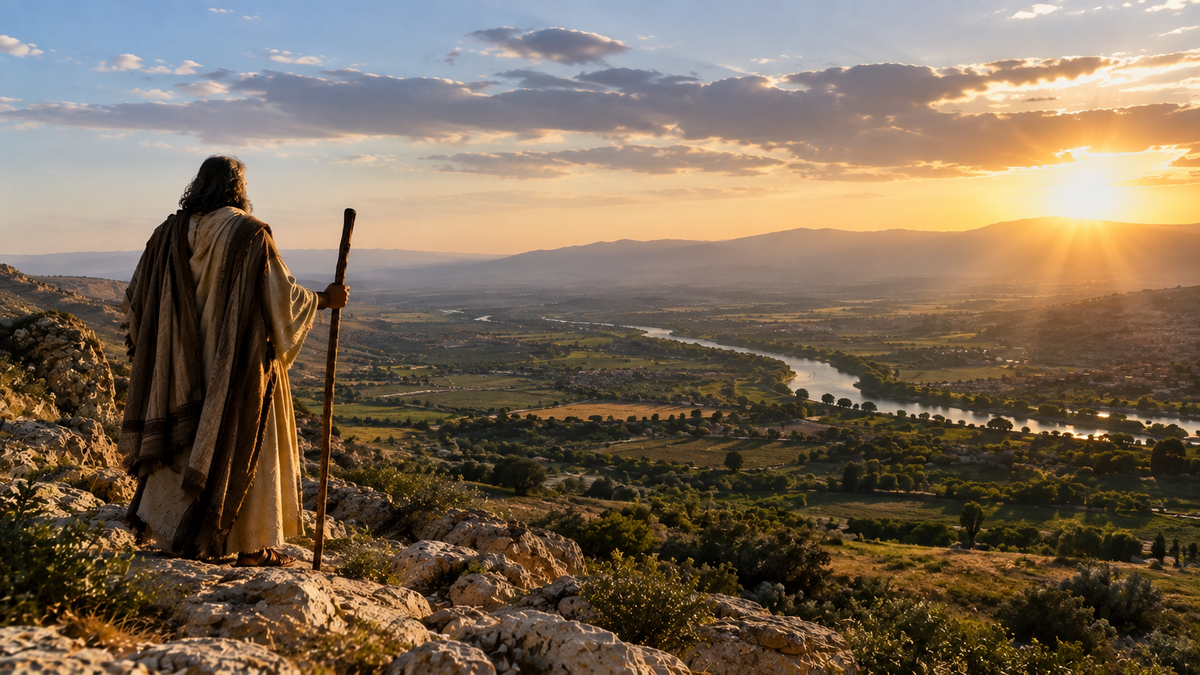
Last night at Anchor Group, we closed out the book of Deuteronomy. We've been walking through it together for a while now, and chapter 34 was our last stop. It's a short chapter, just twelve verses, but it hits hard.
Moses climbs Mount Nebo. God shows him the whole land, from Gilead to Dan, all the way to the western sea. Then the Lord says, "This is the land I promised... I have let you see it with your eyes, but you will not cross over into it" (Deuteronomy 34:4).
And then Moses dies. Right there, looking at the thing he had spent forty years walking toward.
I'll be honest. I didn't plan what came next. I just threw a question into the room: "What do you guys think? Was Moses really successful?"
The room came alive
We had somewhere between 15 and 20 people in the house, and within seconds everyone wanted to talk. Some people had clearly been thinking about this for a while. Others worked it out as they spoke, which I love. You could see people changing their minds halfway through a sentence.
I sat back and listened, and I have to say, it moved me. We're a growing church, and last night I saw that we're also a thinking church. People didn't give the Sunday-school answer and move on. They wrestled with it.
Most of the group landed on yes, Moses was successful, and their reasoning was solid. His job was to get Israel to the edge of the promise, and he did. A whole generation that grew up in the wilderness was standing at the Jordan, ready to cross. By that measure, the mission was complete. Whether Moses personally walked in was almost beside the point.
Someone else brought up Joshua. Moses didn't just lead people. He raised up the next leader. Deuteronomy 34:9 says Joshua "was filled with the spirit of wisdom because Moses had laid his hands on him. "Back in chapter 31, Moses stands before all Israel and tells Joshua, "Be strong and courageous... The Lord himself goes before you" (Deuteronomy 31:7–8). That's a man who knew his time was ending and made sure the promise would outlive him.
I agree with all of that.
It was never about the finish line he could see
Here's where I landed.
Success, in God's economy, is not measured by what you personally get to hold in your hands. The question is how you end in God's eyes.
On paper, Moses' ending looks like a disappointment. He struck the rock when God told him to speak to it (Numbers 20:12), and he never crossed over. But Scripture closes his story with this: "No prophet has risen in Israel like Moses, whom the Lord knew face to face" (Deuteronomy 34:10). That's God's verdict.
His success was also about what he left behind. When Moses learned he wouldn't enter the land, his first concern was the people. He asked God for a leader "so that the Lord's people will not be like sheep without a shepherd" (Numbers 27:17), and he laid his hands on Joshua in front of everyone.
That handover was forty years in the making. Joshua fought beside him, climbed Sinai with him, and stayed in the tent of meeting when Moses spoke with God (Exodus 33:11). So God could tell Joshua, "As I was with Moses, so I will be with you" (Joshua 1:5).
As a leader, that challenges me. Many of us are good at doing the work but not at handing it over. Moses shows that sometimes the win is that the next person is ready (2 Timothy 2:2).
Moses didn't cross the Jordan. But the man he raised up did, and he took a whole nation with him.
He did stand in the Promised Land eventually
This part gives me goosebumps every time.
Fast forward roughly 1,400 years. Jesus takes Peter, James and John up a high mountain, and He is transfigured before them. His face shines like the sun. And who appears next to Him? Moses and Elijah (Matthew 17:1–3).
Think about where that mountain is. Moses, who was told he would not cross over, is now standing inside the land, talking with the Son of God. Luke tells us what they talked about: Jesus' "departure," which in the Greek is literally His exodus, which He was about to accomplish at Jerusalem (Luke 9:30–31).
So the man who led the first exodus is on the mountain discussing the greater one. God didn't cancel His word to Moses. He just had a far better answer than Moses could have imagined on Mount Nebo.
Palace, wilderness, palace
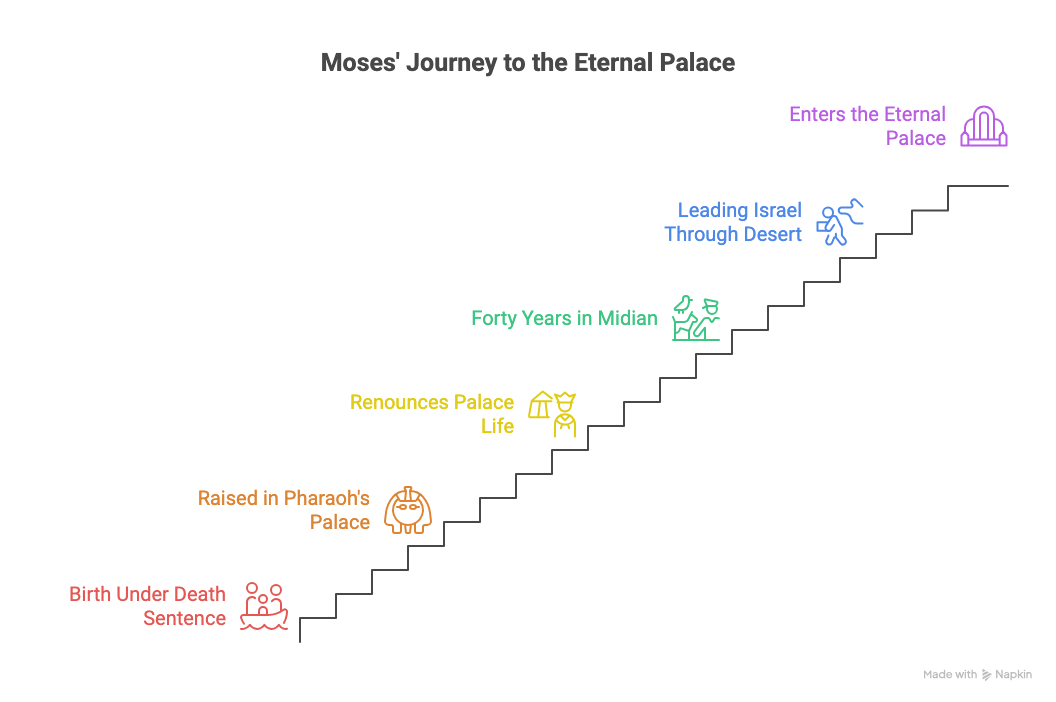
When I look at the full arc of Moses' 120 years, I see three movements.
He was born under a death sentence and ended up raised in Pharaoh's palace, educated in all the wisdom of Egypt (Acts 7:22). Then he gave it all up. Hebrews 11:24–26 says he refused to be called the son of Pharaoh's daughter, "choosing to be mistreated along with the people of God rather than to enjoy the fleeting pleasures of sin," because "he was looking ahead to his reward."
Then came the wilderness. Forty years as a shepherd in Midian, and another forty leading a stubborn, complaining nation through the desert.
And then, I believe, back to a palace. Not Pharaoh's, but the real one. The eternal one. He traded a temporary throne for a permanent home.
That's the journey. Deuteronomy 34:7 says that at 120 "his eyes were not weak nor his strength gone. " He didn't fade out. He finished strong, handed over the baton, and went home.
The legacy is still running
We're still talking about this man thousands of years later. The Law he received shaped a nation. The story of Israel, and God's faithfulness to His covenant promises, didn't end on Mount Nebo. It kept going because Moses was faithful with what God put in his hands during his lifetime.
Hebrews 11:39 says of Moses and the other heroes of faith that they were "commended for their faith, yet none of them received what had been promised. "God had something better planned. They were part of a story bigger than their own lifetimes.
So what does this mean for us?
This is where it gets personal, and I'll own it for myself first.
A lot of us measure our lives by what we can see. The promotion. The house. The ministry numbers. The kids turned out exactly how we hoped. And some of us are quietly carrying the fear that we'll get close to something God promised and not see it happen in our lifetime.
Moses tells me that's okay. Faithfulness is the assignment. The outcome belongs to God. Paul said it near the end of his own life: "I have fought the good fight, I have finished the race, I have kept the faith" (2 Timothy 4:7). He didn't say "I got everything I wanted."
The words I want to hear at the end are not "You made it into every promised land." They're "Well done, good and faithful servant" (Matthew 25:21).
Now it's your turn
We had a great conversation last night, but I know some of you were thinking things you didn't get to say. And some of you weren't there at all. So let's keep it going here. Drop your thoughts in the comments:
- Do you think Moses was successful? Would you define success differently after reading Deuteronomy 34?
- Is there a "Mount Nebo" in your life right now, something you can see but aren't sure you'll get to walk into?
- Who is your Joshua? Who are you pouring into so the promise carries on after you?
- What do you hope God says about you when your story is done?
I'd love to hear from you
Jo.
Watch Apostle Priji's full teaching on this series in the playlist below.