Stay Teachable
The wise aren't the people who know the most. They're the people still learning.
First, an apology. I haven't been consistent with these posts lately. Most of my time this month has gone into Bible in October, our challenge to read the whole Bible in one month. If you haven't seen it yet, you can check it out here: [Bible in October]
It's not too late to join in. From 1 November, we'll celebrate everyone who finishes by name on the challenge page. And if you've fallen behind, you have until 30 November to catch up and still make the list.
Now, to today's post.
A few days ago I ran a session at work on growth mindset and continuous development. While I was preparing, one thought kept coming back. Proverbs said this first. Long before anyone ran studies on mindsets, Proverbs was describing two kinds of people: the ones who keep learning and the ones who stop.
Here's the idea I want us to sit with. In Proverbs, the wise aren't the people who know the most. They're the people still learning.
The Wise Keep Adding
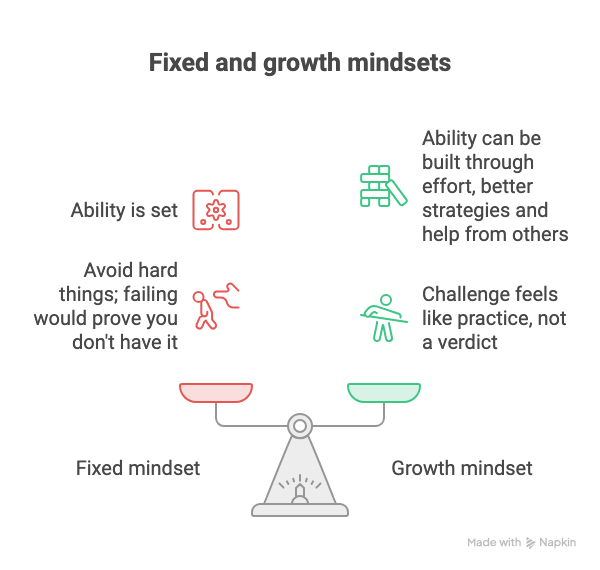
In the session, we started with Carol Dweck's work. Dweck is a psychologist at Stanford, and her research describes two mindsets.
With a fixed mindset, you believe your ability is set. You either have it or you don't. So you avoid hard things, because failing would prove you don't have it.
With a growth mindset, you believe ability can be built through effort, better strategies and help from others. So a challenge feels like practice, not a verdict.
Now read this:
"Let the wise hear and increase in learning, and the one who understands obtain guidance." (Proverbs 1:5, ESV)
And this:
"Give instruction to a wise man, and he will be still wiser; teach a righteous man, and he will increase in learning." (Proverbs 9:9, ESV)
Notice who is doing the learning. It isn't the fool. It's the wise. The person who already understands is the one still asking for guidance.
That turns our usual picture upside down. We think of wise people as finished. Proverbs sees them as people who never stopped being students. Wisdom isn't a finish line. It's a direction you keep walking in.
The day I think I've arrived is the day I stop growing.
Correction Is a Gift You Don't Want
"Whoever loves discipline loves knowledge, but he who hates reproof is stupid." (Proverbs 12:1, ESV)
Proverbs doesn't soften this one. Hating correction isn't called sensitive. It isn't even called proud. It's called stupid.
That's hard to hear, because correction rarely feels like a gift when it shows up. It feels like an attack. Someone points out a gap in my work, and my first instinct is to explain why they've got it wrong.
That's the fixed mindset talking. It hears feedback as a judgment on who I am.
A growth mindset hears the same words differently. Feedback is information. It tells me where to grow next. It's free consulting, and most of us would pay good money for someone to show us our blind spots.
"Whoever ignores instruction despises himself, but he who listens to reproof gains intelligence." (Proverbs 15:32, ESV)
Ignoring correction doesn't protect me. It costs me
Falling Isn't the Opposite of Growing
"for the righteous falls seven times and rises again, but the wicked stumble in times of calamity." (Proverbs 24:16, ESV)
Look closely at that verse. The righteous person falls. Not once. Seven times. Proverbs never says good people don't fall. It says they get back up.
Over the years I have learned that one bad quarter doesn't make a bad company. Nobody serious judges a business on a single result. You look at the track record. How did they respond? What did they fix? Did they come back stronger?
We're usually far harder on ourselves than that. One mistake and we write ourselves off.
Dweck has a simple word for this: "yet". "I can't do this" becomes "I can't do this yet." It's a small word, but it changes the whole story. A failure stops being the last chapter and becomes part of the process.
Falling isn't the opposite of growth. Staying down is.
Nobody Sharpens Alone
"Iron sharpens iron, and one man sharpens another." (Proverbs 27:17, ESV)
You can't sharpen a knife on a pillow. It needs something just as hard pushing back. Growth works the same way. We need people who will challenge us, ask the uncomfortable question and tell us the truth.
We talked about this in the session too. Continuous development isn't only courses and certificates. Most of it happens through people. A manager who coaches you. A colleague who pushes back. A mentor who sees what you can't see yet. A Pastor who corrects you!
So here's a question worth asking. Who sharpens you? And just as important, who are you sharpening?
Even Jesus Grew
"And Jesus increased in wisdom and in stature and in favor with God and man." (Luke 2:52, ESV)
This verse stops me every time. Luke tells us plainly that Jesus grew. He increased in wisdom. If growing was part of his life on earth, I can't treat learning as optional in mine.
Paul says something similar:
"Not that I have already obtained this or am already perfect, but I press on to make it my own, because Christ Jesus has made me his own." (Philippians 3:12, ESV)
This is Paul. He planted churches across the Roman world and wrote letters we're still reading today. And he still says, in effect, "I'm not there yet. I'm pressing on."
And yes, I'm preaching to myself here.
I've tried to hold on to this through my own career. I've moved between very different kinds of work over the years, and the thing that has helped me most isn't a particular skill. It's staying teachable.
That means being open to correction, even when it stings. It means being willing to say, "I don't know this yet. Show me." I've always believed there's room to learn and grow, no matter how long you've been doing something. Some days I live that better than others. But it's the mindset I keep coming back to.
Keep Walking
So let me come back to where we started. The wise aren't the people who know the most. They're the people still learning.
Here's one thing to try this week. Pick one piece of feedback you've been avoiding. Maybe it came from your manager, a friend or someone at home. Instead of defending yourself, ask one question: what if they're right? Then take one small step on it.
That's growth. Not a big leap. One step, then the next one.
If this was helpful, join my free weekly newsletter so the next post lands in your inbox. And if you'd like to keep going on this theme, read [The A-Mindset: Owners Don't Wait to Be Told] and [Was Moses Really Successful?].