Decision-Making Under Pressure: A Framework for Busy Leaders
Busy leaders make hundreds of decisions a day. Here's a practical framework — the Eisenhower Matrix + biblical discernment — for making better decisions under pressure.

Every leader I've ever spoken to about burnout has said some version of the same thing: it's not the volume of work that exhausts me. It's the decisions.
The relentless, never-quite-finished stream of them. The small ones that don't feel worth delegating but accumulate into hours. The big ones that follow you home. The urgent ones that crowd out the important ones. The ones you made badly — or didn't make at all — and are still living with.
Decision fatigue is real. And it's not a sign that you're a bad leader. It's a sign that you need better systems.
In our last leadership post, we used the 5 Whys method to help you stop treating symptoms and start solving root causes. That tool works brilliantly once you're inside a problem. Today I want to give you a complementary tool — one for the moment before the problem gets deep, when you're standing at the fork in the road and someone is waiting for an answer.
The Trap: Treating Everything as Urgent
The single most damaging habit in leadership decision-making is what I'd call the flat-horizon problem: everything looks equally close, equally pressing, equally on fire.
When you operate that way, you make reactive decisions. You decide based on who shouted loudest, what landed in your inbox most recently, or what feels most comfortable to deal with right now. And the things that actually matter — the strategic, the relational, the important-but-not-screaming — get deferred indefinitely.
This connects directly to what we explored in Stop Worrying About What You Can't Control. Just as the Circle of Influence teaches you to direct energy toward what you can actually affect, good decision-making demands the same discipline — redirecting your attention from what feels urgent to what actually matters.
"Trust in the Lord with all your heart and lean not on your own understanding; in all your ways submit to him, and he will make your paths straight." — Proverbs 3:5-6
The Eisenhower Matrix: Simple, Powerful, Underused
Dwight Eisenhower — US Army General, Supreme Allied Commander, and 34th President — reportedly said that the most urgent decisions are rarely the most important, and the most important are rarely urgent.
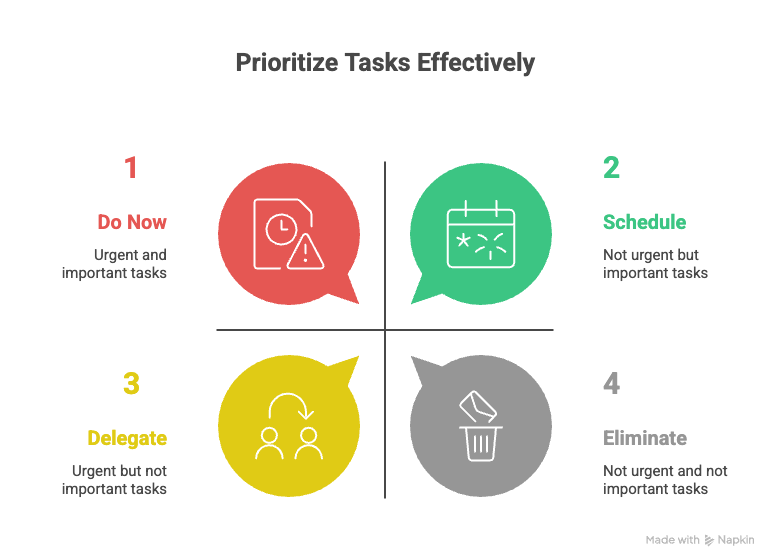
The framework that bears his name organises decisions into four quadrants:
Quadrant 1 — Urgent and Important: Crisis, deadlines, emergencies. These demand immediate attention. But if most of your day lives here, something upstream is broken.
Quadrant 2 — Not Urgent but Important: Strategy, relationships, development, planning, prevention. This is where great leaders invest their best thinking — and where most busy leaders never get.
Quadrant 3 — Urgent but Not Important: Most interruptions, many meetings, other people's minor emergencies. These feel important because they are pressing — but they don't move your real objectives.
Quadrant 4 — Not Urgent and Not Important: Time fillers. Scroll. Noise. Let it go.
The goal isn't to eliminate Q1. It's to invest so heavily in Q2 that Q1 shrinks over time.
Applying This to Decision-Making
When a decision lands in your lap, before you respond, ask two questions: Is this urgent? Is this important?
If it's urgent and important — act. Give it your full attention and make the call. If it's important but not urgent — schedule it. Block time for it. Don't let it get squeezed out by noise. These decisions deserve more than the five minutes between meetings.
If it's urgent but not important — delegate it, or handle it quickly without your full cognitive load. Don't let it masquerade as a strategic decision. If it's neither — let it go. Not everything that arrives needs a response.
The Discernment Layer
For those of us who lead with faith, there is a layer that no framework fully captures: discernment. The capacity to sense what is right beyond what is obvious — to feel the weight of a decision not just in terms of outcomes and risk, but in terms of direction, alignment with values, and long-term consequence.
The Eisenhower Matrix tells you how to prioritise. Discernment tells you how to decide.
And discernment, biblically, comes from two things: proximity to God (the habit of prayer, silence, and Scripture) and the counsel of wise people around you. Proverbs 15:22, which we explored in the 5 Whys post, puts it plainly: plans fail for lack of counsel, but with many advisers they succeed. Great leadership decision-making is not just fast or logical. It is wise.
Building the Habit of Pausing
Most poor decisions under pressure are made in the seconds immediately after a problem lands — before the leader has had time to categorise it, think it through, or consult anyone. The single most underrated decision-making skill is the ability to pause before responding.
Not indefinitely. Not as a way of avoiding the hard call. But long enough to run the two questions: Is this urgent? Is this important? And if it belongs in Q2, to say: I'll give this the focused thinking it deserves — not right now, but I'll get back to you by end of day.
That response, delivered calmly and with confidence, is not a sign of weakness. It is a sign of a leader who has learned that the quality of a decision matters more than the speed of it.
A Practice You Can Start Today
This week, when a decision hits your desk, take thirty seconds before responding. Run it through the two questions. Decide which quadrant it belongs to. Then act accordingly.
You don't need to announce you're doing it. You just need thirty seconds and the discipline to pause before you react. Over time, that pause becomes instinct. And your decisions — and your energy — become much better calibrated.
Leaders who make good decisions under pressure are not gifted with some special clarity gene. They've built a system that creates clarity even when the environment doesn't. Build yours.
ALSO IN THIS SERIES → The Circle of Influence · The 5 Whys Method