How to Give Feedback That Actually Helps: The Leader's Guide
Giving feedback is one of the hardest things a leader does. Here's a practical, biblically-grounded guide to feedback that builds people up instead of shutting them down.

Ask any leader what one of the most difficult parts of their role is, and feedback will almost always appear somewhere in the answer.
Not because they don't care about the people they lead. Usually because they care deeply — and that makes it harder, not easier. You don't want to discourage someone. You don't want to damage the relationship. You've seen feedback given poorly before, and you remember what that felt like. So you soften it past the point of usefulness. Or you delay it until the frustration builds. Or you don't give it at all, and the situation quietly deteriorates.
All three of those outcomes represent a failure of the person being led — even though they were motivated by care.
This post is the fourth in our Leadership & Life series this month. We've looked at the Circle of Influence and where leaders should direct their energy, the 5 Whys method for solving root causes, and a framework for decision-making under pressure. Feedback is where all of those tools meet the human side of leadership.
What the Bible Says About Honest Conversation
"If your brother or sister sins against you, go and point out their fault, just between the two of you. If they listen to you, you have won them over." — Matthew 18:15
The instruction is clear: go directly. Not to others first, not to HR before the individual, not by email to avoid the discomfort of a real conversation. Directly. Privately. With the goal of winning them over — not winning the argument, not protecting yourself, but winning the person.
That phrase — winning them over — reorients everything. Feedback is not a performance review. It is not a record of failure. It is an act of investment in a person you believe can grow.
The Most Common Feedback Mistakes
Before we get to the how, let's name what usually goes wrong.
Vagueness: 'Your communication could be better.' Better than what? In what context? Vague feedback creates anxiety without direction — the person knows something is wrong but has no idea what to actually change.
Ambush timing: feedback delivered in the moment of frustration, in front of others, or immediately after a difficult situation rarely lands well. It feels like a verdict, not a conversation.
The feedback sandwich: you've probably been trained in this — positive, negative, positive — and you've probably noticed that it doesn't work. People see through it. They know the real message is in the middle.
Making it about character instead of behaviour: 'You're disorganised' attacks identity. 'The last three reports were missing the summary section' describes a pattern that can be addressed. One closes the person down. The other opens a conversation.
A Framework That Works: SBI + Intent
The Situation-Behaviour-Impact model (SBI) is one of the most practical tools for structuring feedback clearly and fairly.
Situation: describe the specific context. 'In yesterday's team meeting...' Ground the feedback in something real and observable.
Behaviour: describe what you observed, not what you interpreted or assumed. 'I noticed you interrupted Kate twice before she finished her point' is a behaviour. 'You don't respect your teammates' is an interpretation — and a much harder one to receive.
Impact: share the consequence of the behaviour. On you, on the team, on the outcome. 'It created an atmosphere where others seemed reluctant to contribute.'
To this, I'd add a fourth element: Intent. Ask a question before you conclude. 'I wanted to share this because I think you have strong instincts and I'd like to help you use them even more effectively. What was going on for you in that moment?' That question turns a one-way delivery into a two-way conversation.
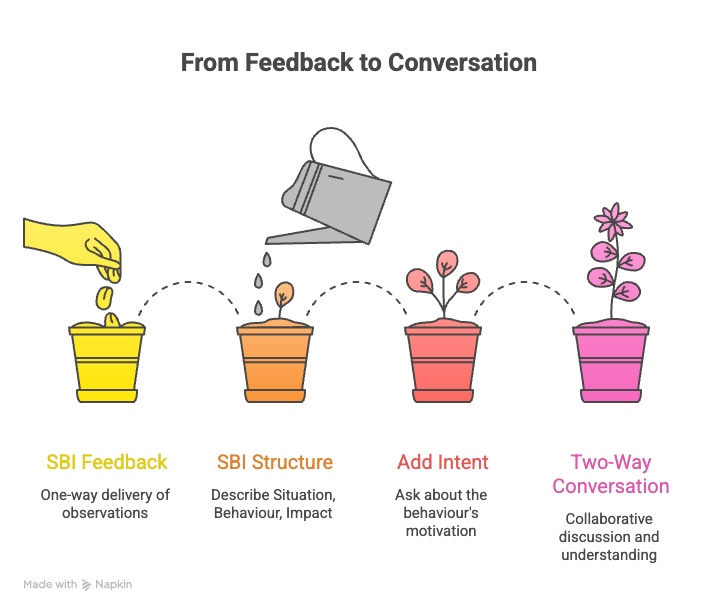
Feedback that invites is more effective than feedback that indicts.
The Relationship Has to Come First
Here's the thing that no framework fully captures but that every experienced leader eventually learns: feedback is only as effective as the relationship it travels through.
If a person does not trust that you are for them — that your investment in their growth is genuine — the most technically perfect feedback will still land as criticism. The words will be heard, but the subtext the person interprets will be: you're not good enough.
This connects to the posture we explored in Stop Worrying About What You Can't Control. A leader who operates from the Circle of Influence — focused on what they can actually affect — invests consistently in the people around them, not just in the moments when performance is lacking. That investment builds the relational infrastructure that makes difficult conversations possible.
If the only time you give someone your full attention is when something has gone wrong, you have conditioned them to associate your engagement with bad news. Invest in the relationship first. The feedback will travel much more easily when the road has been built.
When You're on the Receiving End
A brief note for those of you who are not currently in a formal leadership role, or who are both leading and being led: everything in this post applies in reverse.
How you receive feedback is as important as how you give it. The person who responds to difficult feedback with defensiveness, deflection, or withdrawal makes it harder for their leaders and peers to invest in their growth. And over time, people stop trying.
Receiving feedback well — with curiosity rather than defensiveness, with a genuine desire to understand what the other person observed — is one of the most significant growth levers available to you. And it models exactly the posture you want to create in the people you lead.
What Happens When You Get This Right
The leaders I have most respected — the ones who built teams that were genuinely high-performing and relationally healthy — were not the ones who avoided hard conversations. They were the ones who had them early, often, and well.
People knew where they stood. There were no festering undercurrents of unspoken frustration. Growth was expected and supported, not just demanded. And critically — people trusted that the feedback they received was given in their interest, not against them.
That kind of culture doesn't happen by accident. It is built, conversation by conversation, by leaders who have done the work of learning to speak truth with grace.
Start practising. The conversations you've been putting off are probably the ones that matter most.
ALSO IN THIS SERIES → Decision-Making Under Pressure (Apr 14) · The 5 Whys Method · Next: Delegation Isn't Laziness — It's Leadership (May 12)