Stop Worrying About What You Can't Control — Focus Here Instead
Learn how the Circle of Influence framework can reduce anxiety and make you a better leader. A practical guide for work, life, and personal growth
Leadership & Life Series
There's a concept I've been sitting with lately that came up in a professional development session at work. It's not new — Stephen Covey introduced it decades ago in The 7 Habits of Highly Effective People — but hearing it again at the right moment hit differently.
It's called the Circle of Concern vs. the Circle of Influence.
And honestly? It might be one of the most practically useful mental frameworks I've come across — whether you're leading a team, navigating a difficult season, or just trying to get through a week without burning ou
Two Circles That Explain a Lot
Here's the basic idea.
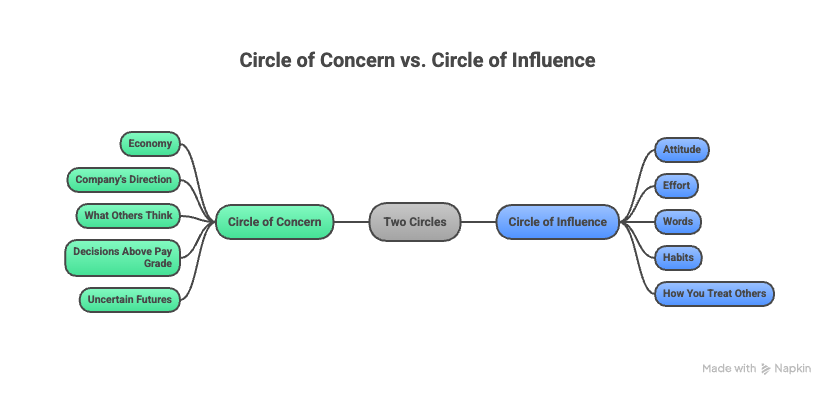
Imagine two circles, one inside the other. The outer circle is your Circle of Concern. It holds everything you think about, worry about, and care deeply about — the economy, your company's direction, what other people think of you, decisions made above your pay grade, uncertain futures. Real things. Valid concerns. But things you cannot directly change.
The inner circle is your Circle of Influence. This is the smaller, more focused space of things you can actually affect — your attitude, your effort, your words, your habits, how you treat the person in front of you today.
Most of us spend the majority of our mental energy in the outer circle.
And it's exhausting.
The Cost of Living in the Outer Circle
Think about the last time you lay awake at night. What were you thinking about?
Probably not the things you could fix by morning. More likely it was the things completely outside your reach — a decision someone else made, a situation you couldn't predict, a worry about something that may never even happen.
When we live primarily in our Circle of Concern, a few things happen. Our stress levels rise. Our sense of agency shrinks. We feel reactive rather than intentional. And ironically, the more energy we pour into what we can't control, the less energy we have for what we actually can influence.
Leaders who operate mostly in the outer circle are often exhausting to be around — not because they don't care, but because their anxiety becomes contagious. They spend meetings talking about problems rather than solutions, about what others aren't doing rather than what they themselves can do.
What Shifts When You Focus on Your Circle of Influence
Here's where the real work happens.
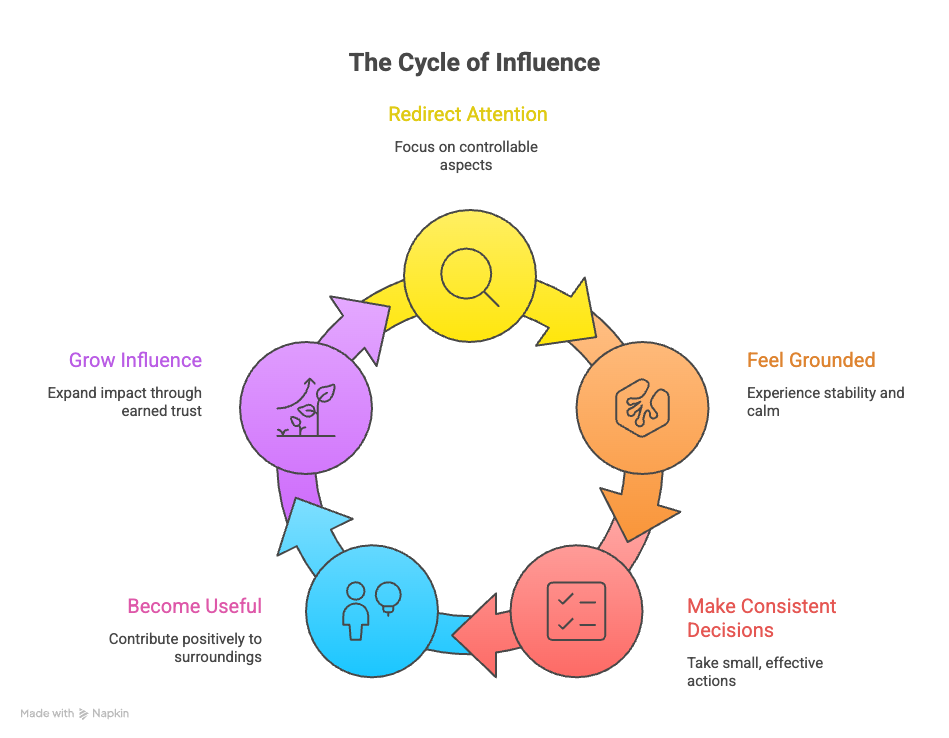
When you consciously redirect your attention to your Circle of Influence, something interesting begins to occur. You feel more grounded. You start making small, consistent decisions that actually move things forward. People around you notice a difference — not because you've become indifferent to the bigger picture, but because you've become useful within it.
Your Circle of Influence includes things like your integrity, your work ethic, the quality of your communication, how you show up when things are hard, your willingness to keep learning, the culture you create in your corner of the world. None of these are flashy. But over time, they compound.
And here's the quiet irony — the more faithfully you tend to your Circle of Influence, the more that circle grows. Influence expands when it's earned, not when it's chased.
A Simple Frame to Carry With You
I've started using this as a personal filter, especially in moments of frustration or anxiety:
"Is this in my circle or not?"
If it's not — I try to release it. Acknowledge the concern, then consciously choose not to camp there.
If it is — I ask what the next right action is. Not the perfect action. Just the next one.
It sounds almost too simple. But simple tools, used consistently, create real change.
A line I keep coming back to that sums it up well:
Be responsible for what you can influence. Trust the process for what you can't.
This Applies Beyond the Workplace
I want to be honest — I first picked this up in a professional context, but I've found it bleeding into every area of my life. As a parent, in relationships, in how I think about the future.
The truth is, most of our anxiety comes from trying to hold onto things that were never ours to control in the first place. And most of our growth — real, lasting growth — comes from the quiet, unglamorous work of tending what is.
So here's my challenge to you this week: draw your two circles. Write down what's in each one. Then pick one thing in your Circle of Influence and do it — with full attention, full effort, full heart.
That's where leadership actually lives. Not in controlling the outcome, but in showing up faithfully for the process.
The world will always give us reasons to worry about things beyond our reach. But growth rarely happens there. It happens when we quietly commit ourselves to the small circle of things placed in our hands today.
This post is part of the Leadership & Life series. If this resonated, you might also enjoy the Financial Stewardship series — Extra Income as an Act of Faith and Align Your Wallet with God's Will.